
تعلم اللغة الإنجليزية : 1 – التواصل والتفاوض في مجال الأعمال
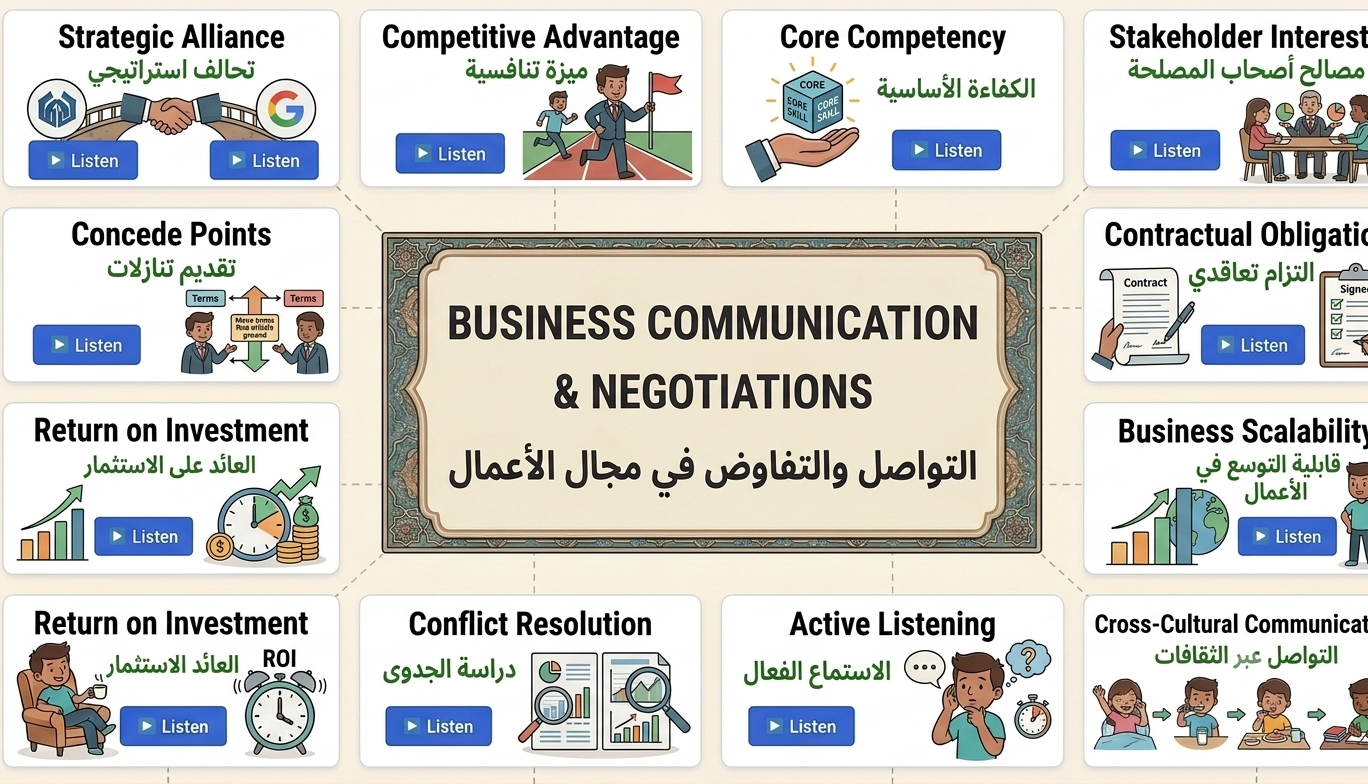
Mastering advanced business communication (التواصل التجاري المتقدم) and negotiation strategies (استراتيجيات التفاوض) is essential for succeeding in international professional environments. Engaging in high-stakes discussions requires precise vocabulary to reach a mutual agreement (اتفاق متبادل), articulate key trade-offs (المساومات الرئيسية), and navigate complex contract terms. In this lesson, you will explore 15 sophisticated expressions along with their Arabic translations and interactive audio tools.
Understanding Advanced Business Concepts in English
When leading executive discussions or negotiating deals, using precise phrasing helps establish authority and clarity:
- Strategic Planning: Organizations focus on achieving a competitive advantage (ميزة تنافسية) by leveraging their core competency (الكفاءة الأساسية) to drive market penetration (اختراق السوق).
- Deal Negotiation: Successful negotiations involve consensus building (بناء التوافق), knowing when to concede points (تقديم تنازلات), and ensuring all contractual obligations (الالتزامات التعاقدية) are satisfied.
- Financial Oversight: Executives analyze the return on investment (العائد على الاستثمار) and conduct thorough risk assessment (تقييم المخاطر) studies to mitigate risks (التخفيف من المخاطر).
Real-Life Executive Dialogue Example
Here is a natural conversation between two corporate managers during a strategy meeting:
- Robert: Welcome to the meeting. Have you reviewed the feasibility study for our foreign expansion?
- Elena: Yes, I have. The market penetration potential looks promising, but we must protect our competitive advantage.
- Robert: Agreed. We also need to leverage our strategic alliance to mitigate risks effectively.
- Elena: Exactly. If we align stakeholder interests, we can ensure a solid return on investment.
📝 تمارين تفاعلية | Practice Exercises – Level 3 : Lesson 1
Lesson Conclusion
Congratulations! You have successfully completed Level 3 – Lesson 1.
In this lesson, you explored executive-level business communication and negotiation concepts. You learned crucial expressions such as competitive advantage, core competency, market penetration, consensus building, conceding points, and mitigating risks.
- Tip of the Day: Using precise business phrases—like “mitigate risks” instead of “reduce bad things” or “return on investment” instead of “profit”—helps build professional credibility and authority in strategic discussions.
Outstanding effort! See you in Lesson 2.